
Roof Ventilation Upgrade in San Bruno, CA
Ventilation is the most undervalued part of a roof replacement. Without balanced intake and exhaust, heat and moisture get trapped in the attic — cooking shingles from below, growing mold, and voiding manufacturer warranties. Every roof replacement we do in San Bruno includes a ventilation assessment, and most include an upgrade to a properly balanced system.
What This Service Includes
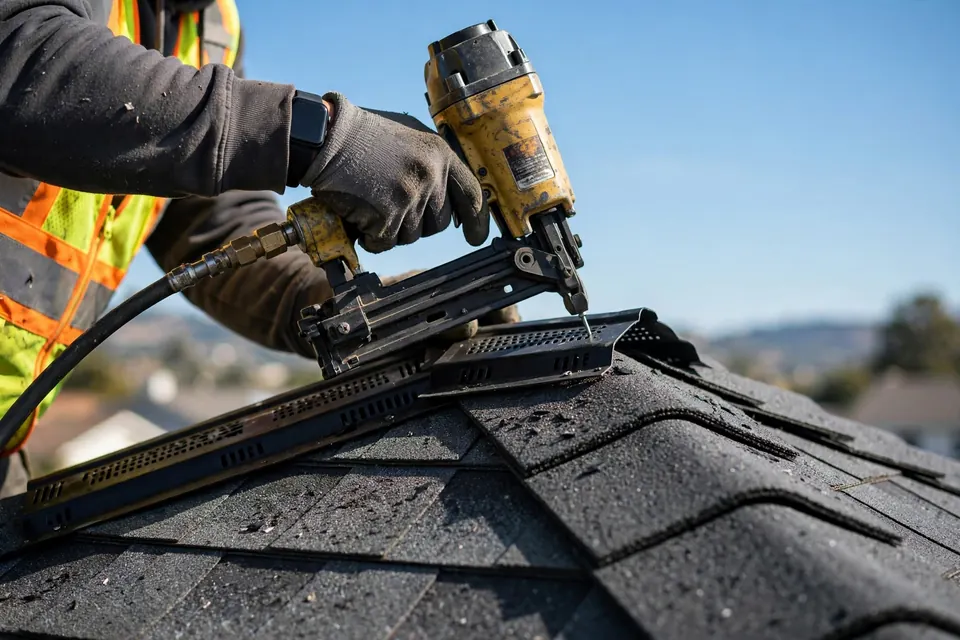
We calculate your attic's net free vent area against the 1:150 (or 1:300 with vapor barrier) standard, then design intake (soffit vents) and exhaust (ridge vent, and in some cases powered or solar vents) as a balanced system. The upgrade happens while the roof is open, when adding ridge vent or correcting blocked soffits is straightforward.
Need roof replacement in San Bruno? Call (888) 974-0663 today.
Call NowEmergency Quick CallSigns You Need This Service
- Excessive attic heat in summer
- Mold or mildew on attic sheathing
- Frost on the underside of the deck in winter
- Curling shingles on a relatively young roof
- Ice dams despite adequate insulation
How We Do It Right
Ridge vent paired with clear soffit intake is the gold standard for most San Bruno homes — silent, passive, and effective. We also correct the common problems we find: painted-over soffit vents, blocked baffles, bathroom fans venting into the attic, and mixed exhaust types fighting each other. Proper ventilation can add years to a new roof's life and is required to keep most manufacturer warranties valid.
Roof Ventilation Upgrade for San Bruno Homes
persistent marine-layer fog, salt air, and gusty Peninsula winds make attic ventilation critical in San Bruno: trapped heat cooks shingles from below and voids warranties. We design balanced ventilation into every replacement.
Related Roofing Services
Tile Roof Replacement
Clay and concrete tile roof replacement in San Bruno, including underlayment renewal — the waterproofing layer that decides a tile roof's life.
Metal Roof Replacement
Standing-seam and exposed-fastener metal roof replacement in San Bruno — 40-70 year lifespan, fire resistance, and energy-saving reflectivity.
Flat Roof Replacement (TPO & EPDM)
TPO, EPDM, and modified bitumen replacement for San Bruno flat and low-slope roofs, with drainage corrected and seams heat-welded.
Storm Damage Roof Replacement
Storm damage assessment, carrier-grade documentation, and full replacement for San Bruno homes hit by marine-layer fog and salt air.
Areas We Serve
Belle Air
Roof replacement in Belle Air, San Bruno.
Downtown San Bruno
Roof replacement in Downtown San Bruno, San Bruno.
Crestmoor
Roof replacement in Crestmoor, San Bruno.
Rollingwood
Roof replacement in Rollingwood, San Bruno.
Helpful Guides
Roof Ventilation During Replacement: The Upgrade Most Homes Need
Guide from Roof Replacement Co.
Energy-Efficient Roofing Options for San Bruno Homes
Guide from Roof Replacement Co.
Frequently Asked Questions
How do I know if my attic ventilation is adequate?
Our inspection measures actual intake and exhaust vent area against your attic square footage. Most homes we inspect in San Bruno are under-ventilated, often significantly.
Is a ridge vent enough by itself?
Only if intake exists to feed it. A ridge vent with blocked or missing soffit vents can actually pull conditioned air from the house. Balance is everything — which is why we design the system, not just the vent.
How do I know if my attic ventilation is bad?
Three tells: the attic feels like a sauna on a warm afternoon, you see moisture staining or mold on the underside of the deck, or your shingles are curling years before their rated life. In San Bruno, fog-belt moisture makes poor ventilation visible as dark staining on the sheathing. Our inspection includes an attic check with photos so you can see what we see.
Will adding ventilation void my shingle warranty or fix it?
It protects it. Major manufacturers require balanced ventilation for their full warranty terms — an unvented attic can reduce coverage. Adding proper intake and exhaust during a reroof brings the system into compliance, which is part of why we treat ventilation as standard scope, not an add-on.
How Roof Ventilation Upgrade Works
Ventilation is the most skipped part of roofing and the one manufacturers care about most — many material warranties require it. The physics is simple: cool air enters at the soffits, warms as it rises through the attic, and exits at the ridge, carrying moisture with it. In San Bruno's fog belt, that moisture removal is the whole game: an unvented attic traps marine-layer damp against the deck's underside, rotting sheathing from inside while the shingles look fine from the street.
Our upgrade starts in the attic, not on the roof: we measure attic volume, check existing intake and exhaust, and look for blocked soffits (painted-over or insulation-choked soffit vents are epidemic in older San Bruno homes). Then we cut continuous ridge vent at the peak, open or add soffit intake, install baffles to keep insulation off the vent path, and verify the balance — roughly equal intake and exhaust, sized to the attic. During a reroof, the incremental cost is small; as a standalone, it is still one of the highest-value improvements a roof can get.
Ventilation Components We Install
Ridge vent is the exhaust standard: continuous along the peak, baffled against wind-driven rain, and invisible from the street. Intake is continuous soffit vent wherever the eaves allow it; where they do not — common on older bungalows with boxed eaves — we use smart vents at the roof edge or gable-to-ridge conversions. Baffles (rafter vents) keep blown insulation from choking the airflow path, which is the silent killer of otherwise good ventilation designs.
We do not install powered attic fans as a first choice: they can depressurize the attic and pull conditioned air from the house, and they fail. Passive balanced ventilation has no moving parts and no energy cost. On tile and metal roofs, the vent strategy adapts — above-sheathing ventilation for tile, ridge venting detailed for metal profiles — but the principle never changes: in at the bottom, out at the top, balanced.