
Commercial Roof Replacement in San Bruno, CA
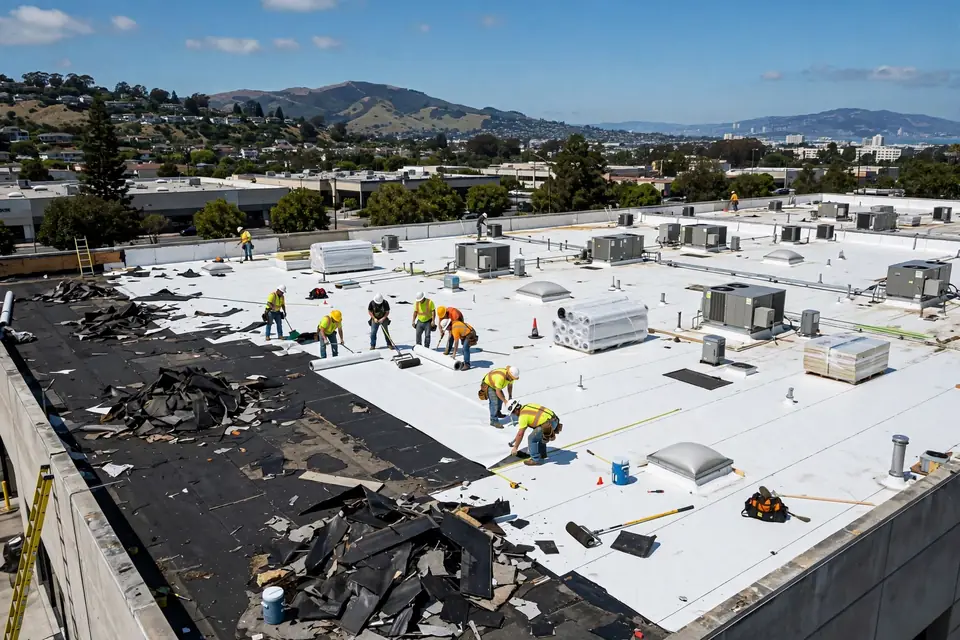
Commercial roof replacement is a different discipline from residential: larger surfaces, occupied buildings below, rooftop equipment everywhere, and a business that cannot stop while the work happens. Our commercial replacements in San Bruno are planned around your operations — phased sections, off-hours work where needed, and constant communication with your facilities team.
What This Service Includes
We survey the entire roof including core cuts to map wet insulation, design the new assembly (typically TPO, EPDM, or modified bitumen over tapered insulation), phase the tear-off so your building is never exposed, and coordinate around HVAC, vents, and equipment curbs. Every phase ends each day watertight.
Need roof replacement in San Bruno? Call (888) 974-0663 today.
Call NowEmergency Quick CallSigns You Need This Service
- Recurring leaks disrupting operations
- Wet insulation found in core cuts or infrared scans
- Ponding water across large areas
- A roof past its warranty with rising maintenance costs
- Energy bills climbing from saturated insulation
How We Do It Right
We install 60- and 80-mil TPO and EPDM, as well as multi-ply modified bitumen where the application calls for it. Tapered insulation design corrects drainage, new flashing details seal every penetration, and we provide manufacturer warranties up to 20-30 years with maintenance plan options. Safety planning, daily cleanup, and tenant communication are built into every commercial project.
Commercial Roof Replacement for San Bruno Homes
San Bruno businesses cannot pause for a roof project. Our phased commercial replacements keep your building watertight and operational from first tear-off to final inspection.
Related Roofing Services
Storm Damage Roof Replacement
Storm damage assessment, carrier-grade documentation, and full replacement for San Bruno homes hit by marine-layer fog and salt air.
Insurance Claim Roof Replacement
We document damage, meet your adjuster, and manage supplements for San Bruno insurance roof replacement claims.
Roof Tear-Off & Redecking
Complete tear-off to the deck with damaged sheathing replaced — the foundation every long-lasting San Bruno roof needs.
Emergency Roof Replacement
Emergency dry-in and fast-tracked full replacement for San Bruno homes with active leaks or storm damage. Call line answered 24/7.
Areas We Serve
Belle Air
Roof replacement in Belle Air, San Bruno.
Downtown San Bruno
Roof replacement in Downtown San Bruno, San Bruno.
Crestmoor
Roof replacement in Crestmoor, San Bruno.
Rollingwood
Roof replacement in Rollingwood, San Bruno.
Helpful Guides
How Much Does Roof Replacement Cost in San Bruno?
Guide from Roof Replacement Co.
Roof Warranties Explained: What San Bruno Homeowners Actually Get
Guide from Roof Replacement Co.
Frequently Asked Questions
Will we need to shut down during replacement?
Rarely. We phase the work so only one section is open at a time, keep noise and odor controlled, and can schedule disruptive operations for off-hours. Most businesses operate normally throughout.
How do you handle rooftop HVAC and equipment?
We coordinate with your mechanical contractors, temporarily detail around equipment, and install new curbs and flashing as needed. Equipment stays in service except for brief, scheduled windows.
Can you replace our roof without closing the business?
Yes — that is the normal way commercial work is done. Phased sections keep every area watertight overnight, noisy operations are scheduled around your hours, and tenant notifications go out in advance. Retail and office buildings in Bayhill and Tanforan have all been completed with zero closure days.
How do we know the new commercial roof is actually watertight?
Three verifications: flood-testing or electronic leak detection on completion for qualifying systems, a manufacturer inspection for warranted projects, and our own final walkthrough with the property manager — on the roof, not in an office. You get the warranty registration, as-built drawings of the taper layout, and a maintenance schedule in a closeout package.
How Commercial Roof Replacement Works
Commercial replacement is phased by design: the building stays watertight and operational every night. We divide the roof into sections and complete tear-off, insulation, and membrane on one section before opening the next — no roof goes home exposed. For Bayhill office buildings and Tanforan retail, that phasing is coordinated with tenants: noisy tear-off during low-traffic hours, quiet detailing during business hours, and a single point of contact who answers the property manager's phone.
The survey comes first and it is thorough: core cuts to verify existing layers and deck type, infrared or nuclear moisture scanning on large roofs to map wet insulation (replacing dry insulation is waste; leaving wet insulation is failure), and a drainage study. Ponding areas get tapered insulation crickets designed into the new system. The proposal is section-by-section with a schedule, so the property manager knows exactly which part of the building is active on which day.
Commercial Systems and Specifications
Most San Bruno commercial replacements are TPO or EPDM single-ply over tapered polyiso insulation, with a high-density cover board for puncture resistance — 60-mil membrane minimum, heat-welded (TPO) or fully adhered (EPDM) seams, and corrosion-resistant edge metal. Buildings with rooftop equipment get walk pads on service paths; equipment curbs are reflashed as part of the system, not left as the old roof's leftovers.
Specifications are written, not verbal: membrane thickness and manufacturer, insulation R-value and taper design, fastening patterns per the wind zone, and the warranty terms — we offer manufacturer-backed system warranties up to 20 years on qualifying commercial projects. Maintenance plans follow: semiannual inspections, drain clearing before the rainy season, and a roof access log. A commercial roof is an asset; we treat the paperwork like it.