
Partial Roof Replacement in San Bruno, CA
Not every failing roof needs a full replacement. When damage is confined to one or two slopes — a wind-torn south face, a failed valley, a hail-beaten elevation — a partial roof replacement addresses exactly what is failing while preserving the sections that still have years of service left. In San Bruno, we recommend partial replacement only when an honest assessment shows the remaining roof genuinely has life in it.
What This Service Includes
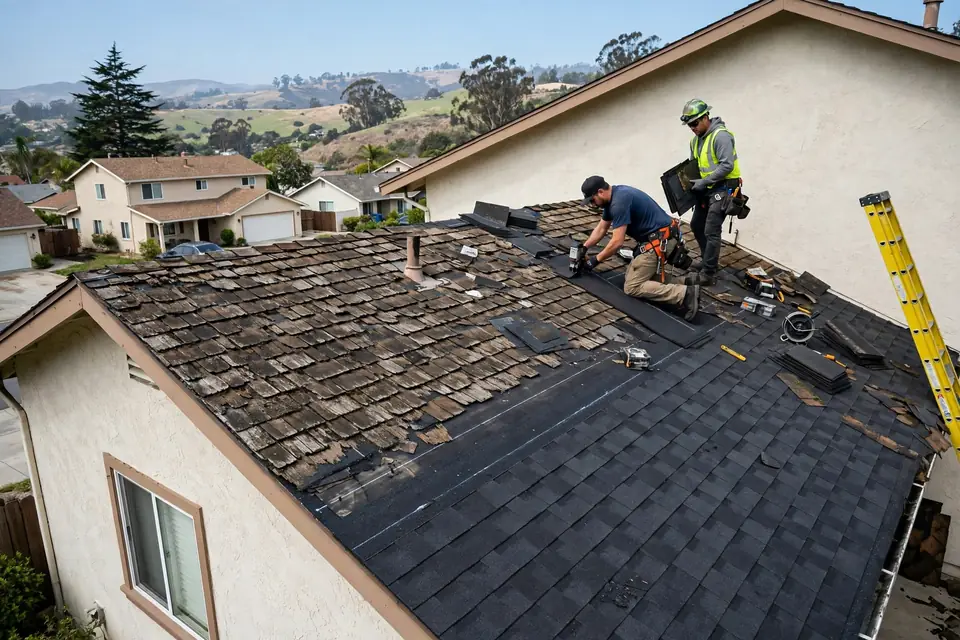
We tear off and replace only the failed sections, tying the new roofing into the existing roof with proper weaving, flashing transitions, and underlayment overlaps. The critical skill in partial work is the tie-in: done right, it is watertight and visually consistent; done poorly, it is a leak waiting to happen.
Need roof replacement in San Bruno? Call (888) 974-0663 today.
Call NowEmergency Quick CallSigns You Need This Service
- Damage isolated to one slope or elevation
- A failed addition or dormer roof while the main roof is sound
- Valley or flashing failures on an otherwise healthy roof
- A roof under 15 years old with localized storm damage
- Budget constraints that make phasing the work sensible
How We Do It Right
We match existing shingle color and profile as closely as current manufacturing allows, and we are upfront about the one real tradeoff: new shingles next to weathered ones will show a visible difference until the older sections age. When the remaining roof is within a few years of replacement anyway, we will tell you that a full replacement is the better value — partial work should never be a sales tactic.
Partial Roof Replacement for San Bruno Homes
For San Bruno homes where damage is isolated — a wind-torn elevation here, a failed valley there — partial replacement delivers exactly what is needed without paying for what is not.
Related Roofing Services
Tile Roof Replacement
Clay and concrete tile roof replacement in San Bruno, including underlayment renewal — the waterproofing layer that decides a tile roof's life.
Metal Roof Replacement
Standing-seam and exposed-fastener metal roof replacement in San Bruno — 40-70 year lifespan, fire resistance, and energy-saving reflectivity.
Flat Roof Replacement (TPO & EPDM)
TPO, EPDM, and modified bitumen replacement for San Bruno flat and low-slope roofs, with drainage corrected and seams heat-welded.
Storm Damage Roof Replacement
Storm damage assessment, carrier-grade documentation, and full replacement for San Bruno homes hit by marine-layer fog and salt air.
Areas We Serve
Belle Air
Roof replacement in Belle Air, San Bruno.
Downtown San Bruno
Roof replacement in Downtown San Bruno, San Bruno.
Crestmoor
Roof replacement in Crestmoor, San Bruno.
Rollingwood
Roof replacement in Rollingwood, San Bruno.
Helpful Guides
Roof Repair vs. Replacement: How San Bruno Homeowners Should Decide
Guide from Roof Replacement Co.
How Much Does Roof Replacement Cost in San Bruno?
Guide from Roof Replacement Co.
Frequently Asked Questions
Will a partial replacement match my existing roof?
We match manufacturer, color, and profile as closely as possible. There will be some visible difference between new and weathered shingles, which we discuss honestly before you decide.
Is a partial replacement cheaper in the long run?
It costs less today. But if the rest of the roof fails in three years, two mobilizations can exceed the cost of doing it all at once. We give you both numbers so you can decide with full information.
Will a partial replacement look mismatched?
Initially, somewhat — new shingles next to weathered ones is visible up close. We minimize it by matching profile and color as closely as current products allow and placing transitions at natural breaks like valleys and ridges. Within a year of San Bruno sun and fog, the new section weathers in and the difference fades. We show you the match sample before work starts so expectations are set.
When is partial replacement the wrong choice?
When the rest of the roof is within five years of end of life, or when leaks are appearing on multiple slopes. Paying for a partial now and a full replacement in three years costs more than doing the full job once — two tear-offs, two dumpsters, two mobilizations. Our inspection gives you the roof's honest remaining life so the math is yours to make.
How Partial Roof Replacement Works
Partial replacement makes sense in exactly one situation: part of the roof is done and the rest has real life left. The classic San Bruno case is a south-facing slope cooked by UV while the north slope still looks fine, or a wind-torn section on an otherwise healthy 12-year-old roof. We verify the rest of the roof's condition first — selling a partial on a roof that needs full replacement in three years is false economy, and we will tell you when that is the case.
The work itself is all in the tie-ins. The damaged section is torn to the deck, redecked as needed, and rebuilt with new underlayment, flashing, and shingles woven or flashed into the existing roof at valleys, ridges, and walls. Material matching is the craft: we source the closest current profile and color to the existing shingles, and we are honest that a 10-year-old roof has weathered — the new section will look new, and blend over the first year. The replaced section carries our full workmanship warranty; the tie-in detailing is what makes it watertight.
Matching Materials and Tie-In Details
Shingle manufacturers discontinue colors and profiles constantly, so matching starts with identifying what is on the roof — we pull a sample shingle and check current lines plus distributor old-stock. When an exact match is impossible, we place the new section where the transition reads naturally (a valley or ridge line) and choose the closest blend. Underlayment and flashing in the new section are new and current-spec regardless: ice-and-water membrane in valleys, corrosion-resistant flashing at walls.
Valley tie-ins get woven or closed-cut detailing depending on the existing valley style, and ridge tie-ins are re-capped across the transition so the ridgeline reads as one roof. Pipe boots and vents inside the replaced section are all new. The result should shed water as a single system — because from the rain's perspective, it is one.