
Roof Repair vs. Replacement: How San Bruno Homeowners Should Decide
The repair-vs-replace decision comes down to three things: the roof's age, the extent of the damage, and the math. Here is how to think about each.
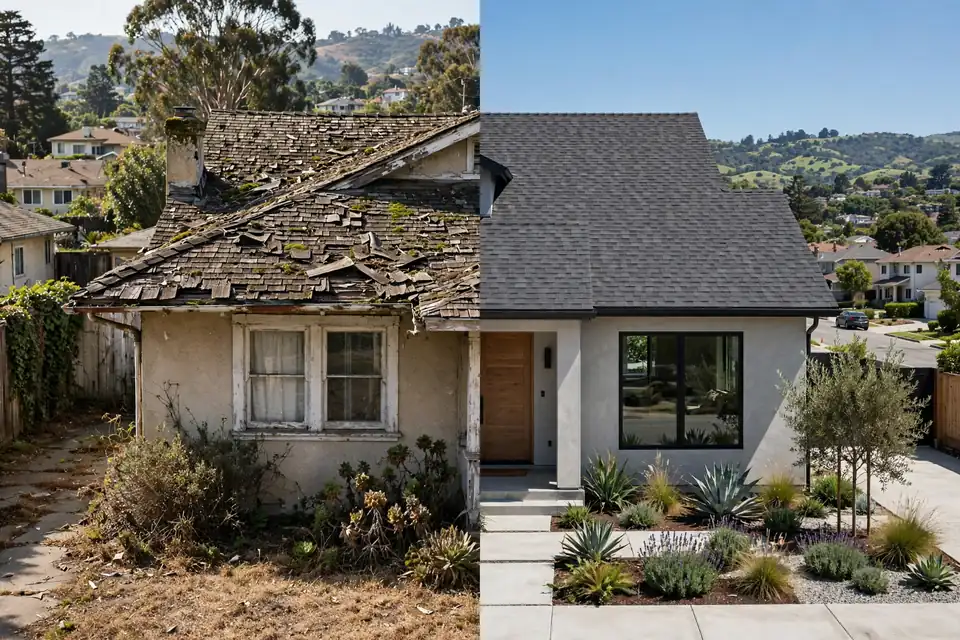
Start with the roof's age
A 10-year-old architectural shingle roof with a localized leak is a repair candidate. A 24-year-old roof with the same leak is a replacement candidate wearing a repair's clothing. Age sets the context for every other factor.
Map the extent of the damage
One failed valley or a small wind-damaged area points to repair. Multiple leaks, widespread granule loss, or damage across several slopes points to replacement. We document damage slope by slope so you can see the pattern, not just hear our opinion.
Do the five-year math
Add up the repair cost plus the likely cost of the replacement you will still need in a few years, and compare it to replacing now. Repairs on a dying roof are often 30-50 percent of a replacement — spent for two or three years of borrowed time.
Consider the hidden factors
Insurance may cover replacement after storm damage but not wear. Selling soon? A new roof is a strong listing asset in San Bruno's market. Layering repairs onto a roof with multiple existing layers can also create weight and code issues.
Need roof replacement in San Bruno? Call (888) 974-0663 today.
Call NowEmergency Quick CallRelated Services
Areas We Serve
Belle Air
Roof replacement in Belle Air, San Bruno.
Downtown San Bruno
Roof replacement in Downtown San Bruno, San Bruno.
More Guides
How Much Does Roof Replacement Cost in San Bruno?
Guide from Roof Replacement Co.
7 Signs Your San Bruno Home Needs a Roof Replacement
Guide from Roof Replacement Co.
Frequently Asked Questions
Will a roofer honestly tell me when repair is enough?
We will — and we do regularly. Repairs are profitable work; we recommend them whenever they are genuinely the right call. Our reputation in San Bruno depends on that honesty.
Can I do a partial replacement instead?
When damage is confined to one or two slopes and the rest of the roof is healthy, a partial replacement splits the difference well. We offer it whenever the assessment supports it.
The 25 Percent Rule, San Bruno Edition
Roofers use a rough rule: if more than about 25 percent of the roof needs repair, replacement is usually the better economics. In San Bruno, adjust that rule for the fog belt — moisture damage spreads invisibly, so a roof that looks 20 percent damaged on the surface is often 35 percent damaged once the deck is exposed. The repair quote fixes what is visible; the replacement fixes what is there.
Age weights the rule heavily. Repairing a 10-year-old architectural shingle roof after a wind event is sensible. Repairing a 24-year-old 3-tab roof with widespread granule loss is paying for time you will not get — the next slope fails within two seasons, and you have bought two mobilizations instead of one roof. Our inspection gives you the roof's honest remaining life so the rule applies to your roof, not a generic one.
When Repair Is Genuinely the Right Call
Repair wins when the roof is young, the damage is localized, and the cause is identifiable and fixed. A wind-torn valley on a 12-year-old roof, a failed pipe boot, flashing separated at one chimney — these are repairs, and an honest roofer says so. The repair should address the cause (why did that flashing separate?) not just the symptom, and it should be photographed before and after.
Repair also wins as a bridge: when you need two dry seasons before a planned replacement, a properly detailed repair with matching materials buys that time without pretending to be permanent. What repair never wins is concealment — coating over a failing roof, or layering shingles over rot. In San Bruno's moisture, cover-ups fail faster than anywhere, and they always cost more than the replacement they delayed.